Summary
3D observation is necessary. In references, it is needed to understand why shadow shapes are placed where they are, and what primary shapes can be used to make simplifications. Linework is mentioned in the context of supplementing 3D observations.
Methods to enhance detail are also discussed, scaffolding from the two-value base: Weak Tone Variation, Texture, Edge control, Bounce Lights, Back Lights However, a developed value sense is needed to leverage weak tone and other secondary concepts, and to not create unintentional shapes from poor brightness control.
Past lessons and 2-values still are relevant. L2-L4 seem to be a trilogy of sorts. Krenz asks you to note unfamiliar vocabulary and attempt to link concepts together to think using artist terms.
Limiting the value range
Even identifying a 10-value range is tough. We can dumb down the value expression further with the posterize filter, which defaults to 4 levels(values) per hue. For grayscale, this basically breaks down the reference into an X-value study.
- Hard edges become easier to tell when dumbing down the reference. You can literally trace over these value shapes.
Example

3 Brushes
Functions can overlap in a single brush, but the purpose matters more.
- Hard edges, blocking
- Pressure-sensitive or soft brush for tone
- Textured Brush
Reverse Refinement (30m)
Detailing such as textures, edges, and secondary lightning tend to hide the main light-dark shapes. If doing an imitation, run these shapes though a filter, for example by removing gradients. Since art starts from large shapes, you can estimate someone’s process by reversing engineering their refinement stages.
Demonstration
You design details such as edges or secondary light AFTER the main shapes, they bring more merit to an already competent shape that stands on its own merit.


Major shapes stay the same across refinements
Textures and soft edges can be classified as “fake” detail fluff, which tends to be among the first thrown aside in distillations.


Expressing textures/detail with weak tone (1h)
A flat surface can seem textured by creating random patterns using a range of values <1 step. Minor variations of value(weak contrast) can imply a lot more details than one may expect.
Linework may throw off this expression through needless contrast difference if using pure black on an otherwise lighter artwork.
Lines in weak tone (Don't use black lines without a good reason)
A: No lines, it’s just to show the effect of weak tones on the base color blocks
B: The lines match the tone and allow them to be the ones subject to contrast.
C: The overwhelming contrast in the lines makes the weak tone invisible.
The line here is basically the shadow, but shadows aren’t pure black. The best outcome is B, where the line opacity is lower.
There’s basically no way for weak tone to integrate with a pure-black.

Lines to Inform Tone and Light
Lines take a backseat in a painting style. If an object we want to display is lost by cutting the line, it’s probably lacking key tone information.
Example, Intentional shape design (60m)
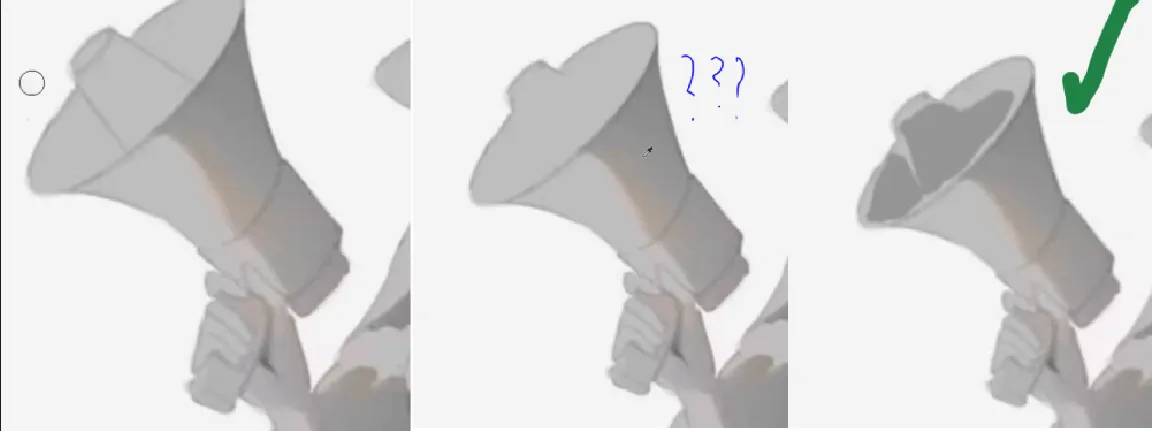
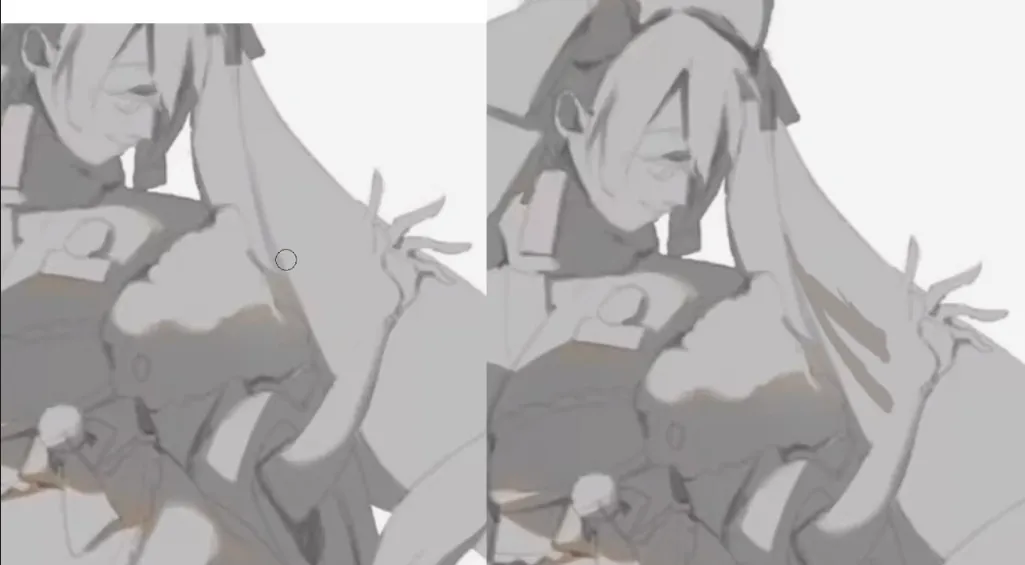
We can recognize a shape if there are enough hints.
Instead of a line, use gestalt theory to complete the hand outline, leveraging the viewer’s ability to infer the whole from deliberate fragments.
Reasoning with lines (1h30m)
Lines instead are to inform in 3D and reason lighting shapes, so we don’t aimlessly block. Cross contours are common to maintain such information.
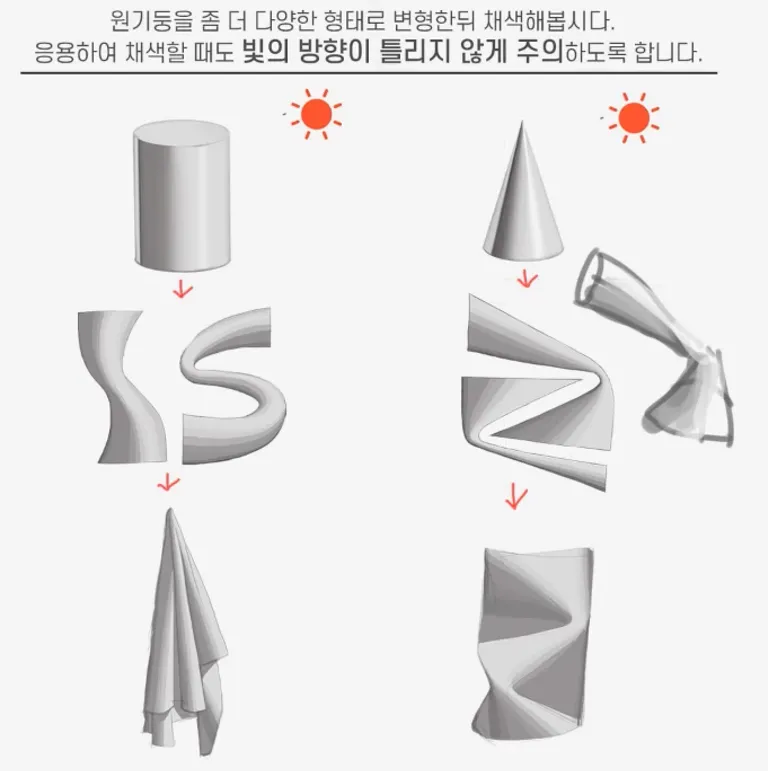
Folds are 3D
Cones, Cylinders, and Apple slices can be spotted in folds. Multiple of them can be arranged to form a pattern that depicts folds.
Focus on one “side” to render
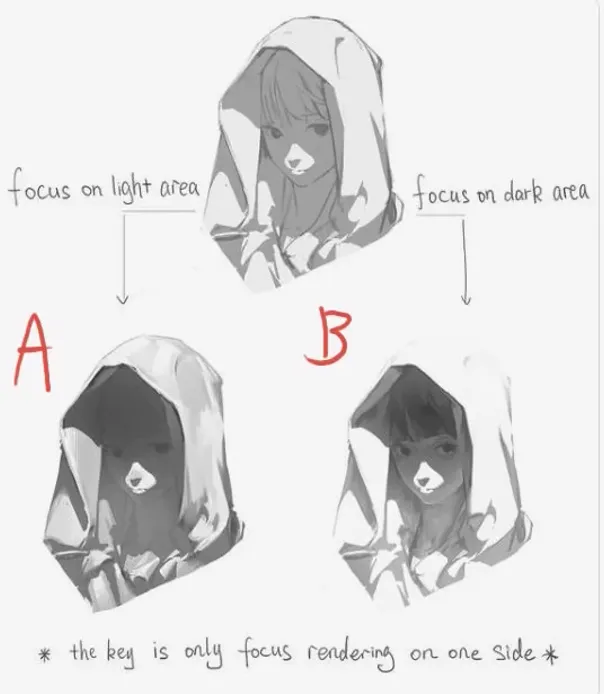
Rendering both shadow and light shapes is a huge cognitive burden. The detail of one side can compensate for the simplicity of the other.
Example
Other Concepts
- Reverse refinement (0-30m) → removing soft edge to find hard shapes of light and shadow. Strengthen contrast to see light-dark boundary if necessary. Also disregard secondary lighting such as bounce light, not concerning the primary light source.
- The main lighting/shadow shapes tend to not change in the refinement shape. When analyzing other artists, we want to filter the noise and textures that hides the hard lighting shapes. Gradients create unclear boundaries for shapes, and we don’t want our imitations to start with them.
- “Fake details” (40m) → semi-random value patterns limited to a range
- Weak contrast → beware lines
- Folds use generic shapes such as cones to inform light.
- Turns can be depicted with an edge degree 2.2. Edges in general need balance, or you risk losing the main shape.
- The third value informs transitions of light and shadow. Values are added incrementally, each with a purpose. Fourth may be a highlight, fifth may be a transition for that highlight.