Summary
Krenz argues the importance of a finding a proper value sense and system. Viewers can be made aware of shapes even with the smallest variations in tone. Tone is important to depict detail, but it is up to the artist to simplify if necessary and still depict the impact. Krenz-Lighting Lecture 2 HW Materials
Minimum Detail Standard
Simplify complex gradients and details into a single value Light is dominated by impact and impression, not the detail.
- go for practicality, what covers the impact with the shortest amount of details possible first. We care more about the information density, rather than something clean and structured, so go fragment lines and let the viewer handle the completion (gestalt theory)
The impression of "many" when zoomed out
The impression of many leaves = Outline + tone NOT drawing every single one
Developing the same impression through lines requires a far more ACQUIRED skillset…
"Painting Over" the reference 2:46:00
Some details are hard to replicate, but wholly unnecessary to the impression. It is up to the painter to filter unnecessary details out.
These complex folds are generalized to a “big-small” pattern
Use Two Value Studies as a base (55:00)
Refer to the assignment for details on how to properly do said studies.
In a two-value study, the only language is shapes. If we use a two-value study as a base, we have an immutable point if we up the complexity and screw up. In other words, we won’t have to waste time fixing any shapes we might destroy in rendering. The only thing we modify are the two tones that are locked in shape.
Preserving the Shapes
Once the two-value distillation is done, select and erase the white shapes. You now have the black and white shapes separate to add tone variation whilst respecting their masks, preserving their shape.
Tone Identification (1:10:00)
Ideally memorize a value scale, and have whatever values you see map to it.

- For reference, this is a 10 value scale that maps to 0-100 on the value slider. There is a clear logic and reasoning behind what values are chosen. If a value is transitioning dark to light, how many steps on the value scale does it take? Values on the same master tone should not depict too drastic of a jump. Krenz calls this a “one-step” difference, or under 10 value. Single digit variations are still noticeable, but errors of 20-30 are quite egregious, and will be recognized as another color block.
- Highlights can be done with only a one-step jump. They still fall under gradation rules relative to the original material, don’t make them white for everything.
- Smaller details can be as little as 1 or 2 DEGREES.
- Better to prioritize accuracy rather than color picking based on hasty impressions.
Needless value jumps create unclear shape language
Here we have two large dark shapes that defined along with their lit counterparts
The issue is that the left thigh has a noticeable >1-step value jump for no good reason. It’s already in the dark, but there is another darker shape. So is it in the light? But there already is a light shape to the right?
The solution then is to significantly soften then contrast of these shapes into the low single digits. They don’t need to stand out, especially when zoomed out they shouldn’t have that much of an impact.
Edges Identification
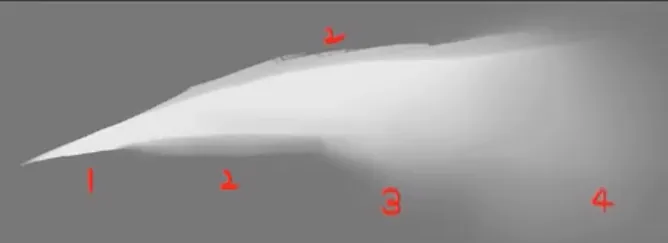
Just like value, edges have a scale 1-4 base on the information lost.
1(sharp)2(firm)3(soft)4(lost)
Other Concepts
- Ambient Occlusion(AO) Painting vs Polygonal Lightning method → simulate 3D based on irl lighting rules. AO method works with more threshold(value), harder for newbies.
- Edge identification 1(sharp)2(firm)3(soft)4(lost)
- Surface reflection of light phenomenon (Bounce light?)
Lingering Thoughts/General Impressions
- Krenz has a way to turn a color reference into two values, and selectively pick out those parts as separate layers. (Threshold or Posterize + Select → Similar)
- I should slow down when it comes to choosing values. With a small color wheel, even minor variations can be too much of an increase. I also don’t really have a sense for light/shadow transitions or highlights, or anything dark for that matter.
- I really underestimated the power of two values. Keeping the main shapes as a mask was also quite obvious in hindsight